Direct answer
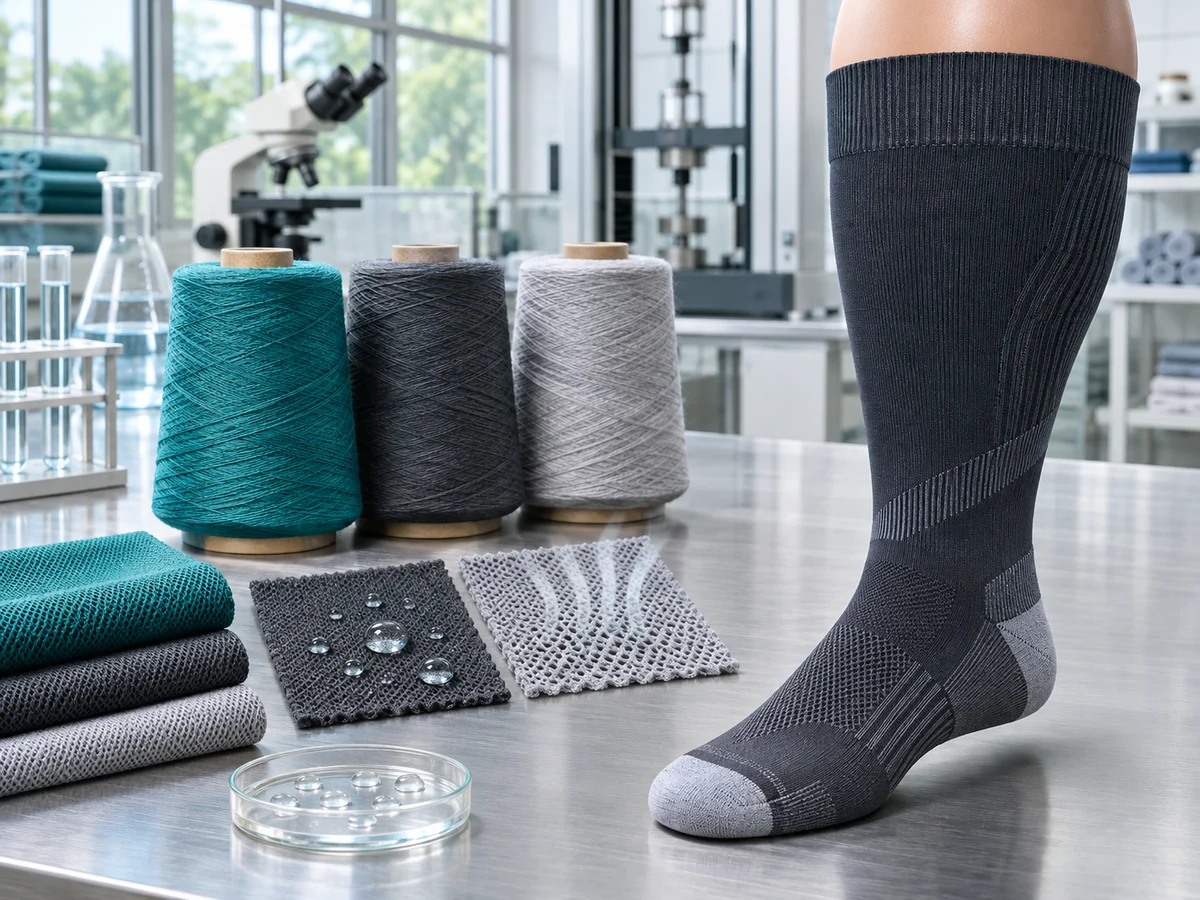
Moisture management depends on the complete sock system: fiber blend, yarn form, knit structure, fit and drying behavior must be evaluated together on the finished wide-calf product.
Key Takeaways
- Compare finished products, not fiber names alone.
- Match yarn choice to pressure and durability.
- Test drying, odor and wash performance.
- Keep claims proportional to evidence.
Compare material systems
Polyamide, polyester, polypropylene, cellulosic fibers and wool blends can all support different product briefs. Their performance changes with yarn engineering and knit structure.
Request comparable prototypes and judge them against the same specification rather than choosing by marketing name.
- Fiber blend percentage.
- Yarn count and texture.
- Elastic yarn integration.
- Supplier traceability.
Protect pressure and fit
A moisture-oriented yarn substitution can change stretch, recovery and hand feel. The wide-calf size matrix and pressure profile must be revalidated after a meaningful material change.
Pay particular attention to the ankle, top band and heel because small dimensional changes affect placement.
- Pressure by size.
- Stretch recovery.
- Heel and toe stability.
- Top-band comfort.
Create a practical test plan
Use lab tests for wicking, drying and colorfastness, then add wear trials across the claimed calf range. Observe damp feel, heat buildup, friction and drying after use.
Repeat key checks after the intended number of wash cycles to understand whether performance is durable.
- Vertical wicking comparison.
- Drying-time comparison.
- Wash-cycle durability.
- Target-user wear notes.
Write accurate product claims
Terms such as moisture-wicking, quick-dry and odor-control should connect to a defined material feature or test. Avoid turning a limited fabric result into a broad health promise.
Give wholesale buyers a concise material sheet with composition, care and approved claims.
- Evidence-backed wording.
- Consistent fiber labels.
- Care compatibility.
- Claim approval record.
Buyer questions
Frequently Asked Questions
Which yarn is best for sweaty feet?
There is no universal best yarn. Finished-sock wicking, drying, fit, footwear and wear conditions should be compared.
Does cotton wick moisture well?
Cotton can absorb moisture but may retain it longer than some engineered blends. The complete construction should be tested.
Do moisture-wicking yarns affect compression?
They can. Any material change may alter elasticity and should trigger pressure and fit revalidation.