Direct answer
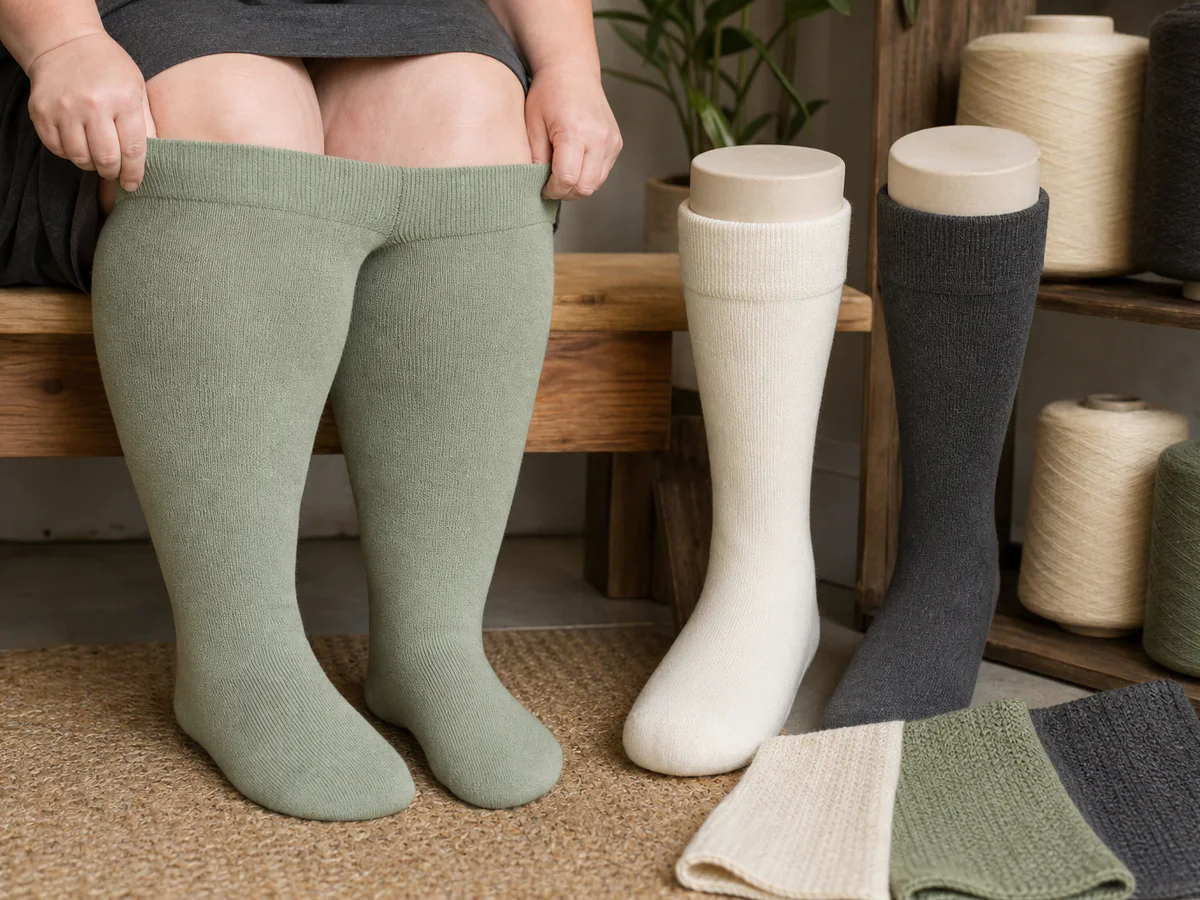
Wholesale bamboo plus size socks should be evaluated as a complete yarn blend and knit construction. Buyers should test softness, moisture handling, pilling, shrinkage, abrasion, cuff recovery and colorfastness instead of assuming the bamboo fiber name guarantees performance.
Key Takeaways
- Confirm the exact fiber composition.
- Evaluate the blend, yarn and knit together.
- Test pilling and abrasion in extended sizes.
- Check shrinkage and cuff recovery.
- Use accurate fiber labeling.
Understand what bamboo means on a sock label
Many products described as bamboo socks use bamboo-derived viscose blended with other fibers. Nylon or polyester may support strength, while elastane provides recovery. The exact percentages should be confirmed for labeling and customs documentation.
A high percentage of one soft fiber does not automatically create the best sock. Extended sizes need enough recovery to stay aligned without becoming restrictive.
Match construction to the intended benefit
A lightweight smooth bamboo blend can suit dress and everyday programs. Cushioning changes warmth and shoe volume. A non-binding version requires a cuff and ankle construction that remains stable over the target circumference.
Define the consumer benefit in practical terms such as soft hand feel, lightweight comfort or everyday moisture management. Avoid claims that the fiber alone cannot support.
Test the weaknesses buyers often overlook
Soft yarns can show pilling or abrasion if the knit is too loose for the use case. Heat and washing can also change dimensions and surface appearance.
Run the intended care cycle before approving color and fit. Inspect the heel, toe, ball of foot and cuff because each zone experiences a different type of stress.
- Dimensional change after washing.
- Wet and dry colorfastness.
- Pilling and surface fuzz.
- Abrasion in high-wear zones.
- Elastic recovery.
Position bamboo within a broader assortment
Bamboo plus size socks can provide a softer alternative within diabetic-style, non-binding, dress and casual collections. They do not need to replace every cotton, wool or performance style.
For B2B buyers, a small coordinated material story is often easier to sell than many nearly identical products. Use clear differences in weight, cushioning and intended season.
Buyer questions
Frequently Asked Questions
Are bamboo socks made from raw bamboo fiber?
Many commercial bamboo socks use bamboo-derived viscose. Buyers should confirm and label the actual fiber composition.
Can bamboo socks be non-binding?
Yes. The non-binding result comes from cuff and leg construction as well as the material blend.
What tests are important for bamboo blend socks?
Shrinkage, pilling, abrasion, colorfastness and elastic recovery are important for repeatable wholesale quality.