Direct answer
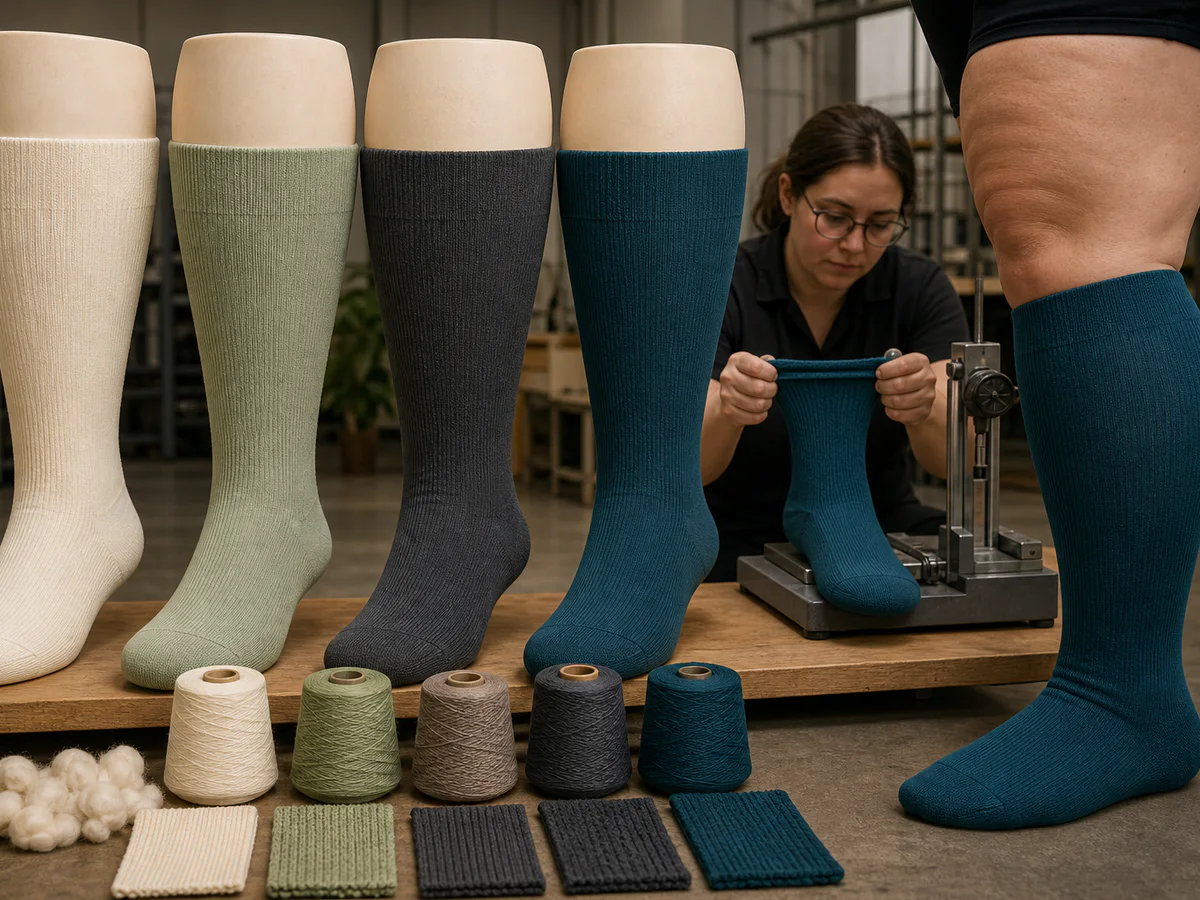
The best plus size sock material depends on use. Cotton supports familiar comfort, bamboo viscose a smooth hand, wool temperature management, polyester moisture performance, nylon abrasion resistance and elastane recovery. The final blend must balance softness with shape retention across wider circumferences.
Key Takeaways
- Choose by use case, not fiber trend.
- Recovery is critical in wide constructions.
- Softness must be balanced with abrasion resistance.
- Cushioning changes heat and shoe volume.
- Test the complete dyed and finished product.
Cotton and cotton-rich blends
Cotton offers a familiar feel and works across everyday, dress and cushioned products. It is commonly blended with stronger synthetic fibers and elastane to improve durability and recovery.
The yarn type and knit density affect softness, weight and drying. A high cotton percentage alone does not guarantee a better extended-size sock.
Bamboo viscose and wool blends
Bamboo-derived viscose can provide a smooth, soft hand suitable for comfort programs. It should be evaluated for pilling, abrasion and dimensional change.
Wool blends can support temperature management and cold-weather ranges. Buyers should define fiber quality, weight and care requirements, especially for products expected to fit a wide leg after repeated washing.
Performance synthetics and recovery fibers
Polyester can support color, moisture movement and durability. Nylon is often used for strength and abrasion resistance. Elastane or similar recovery fibers help the sock return to shape.
More elastic is not automatically better. The placement, covering yarn and knitting tension influence whether the sock feels supportive, restrictive or unstable.
Build a practical material test plan
Compare candidate blends in the final sock construction. Dyeing, heat setting and washing can change both hand feel and dimensions.
For B2B approval, review comfort, pilling, abrasion, moisture behavior, shrinkage, colorfastness and recovery. Select the blend that best serves the channel rather than the one with the longest marketing description.
- Everyday lightweight.
- Cushioned sensitive-foot.
- Performance athletic.
- Cold-weather wool blend.
- Fine-gauge dress.
Buyer questions
Frequently Asked Questions
Which fiber is softest for plus size socks?
Softness depends on fiber, yarn and finishing. Bamboo viscose and fine cotton blends can feel smooth, but samples should be compared directly.
Why is elastane important?
It supports stretch and recovery, helping the sock fit wider circumferences and return toward its original shape.
Is more cushioning always better?
No. Cushioning adds warmth and thickness, which may reduce space inside footwear.