Direct answer
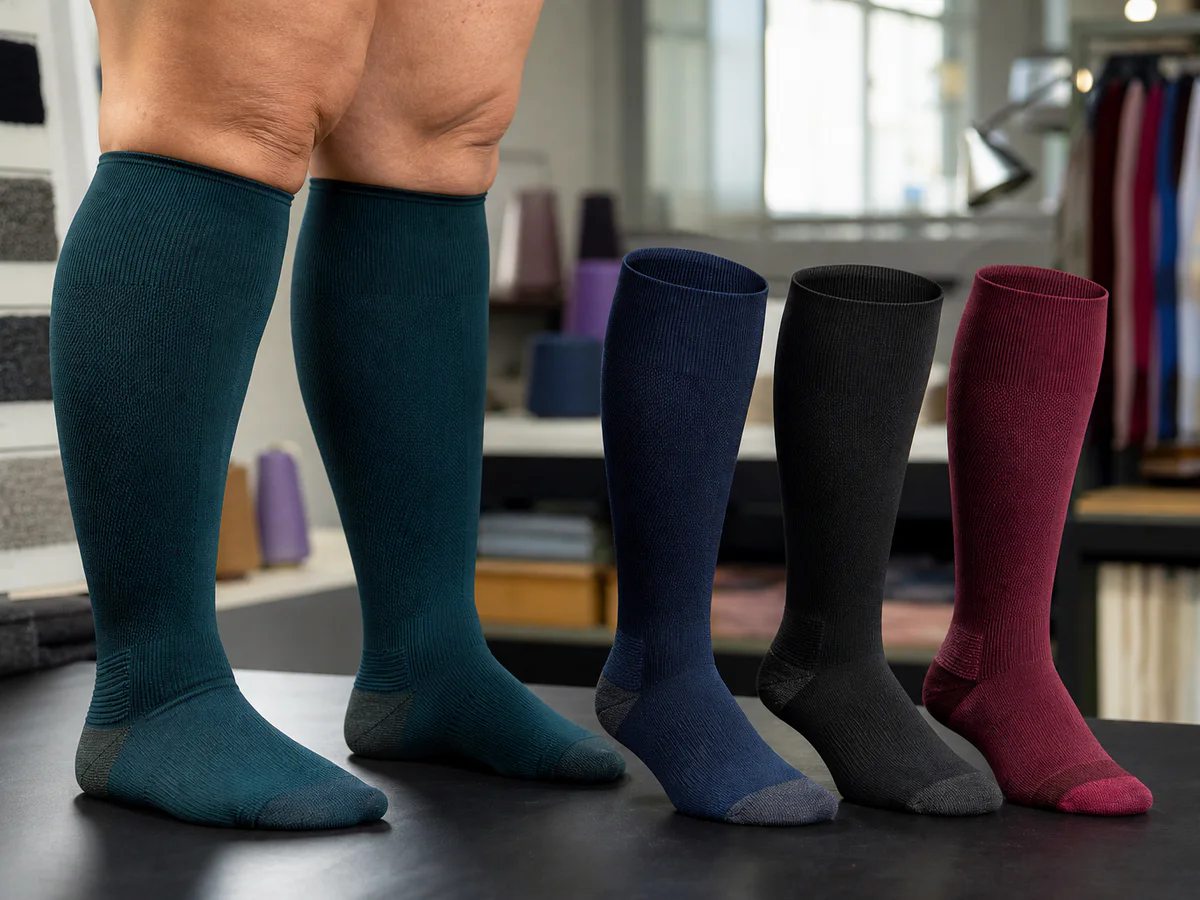
Source wide calf compression socks from a manufacturer that can grade ankle, calf and length independently, verify the stated pressure range on each size, document test methods and reproduce the approved construction in bulk. A sock that is simply tight is not the same as verified graduated compression.
Key Takeaways
- Size primarily from ankle and calf measurements.
- Include leg length to prevent folding.
- Verify pressure on every extended size.
- Approve donning, cuff and toe comfort.
- Review destination-market claims and labeling.
Begin with a pressure and use-case brief
The buyer should define the intended pressure range, wearer profile and use context before selecting colors or graphics. Travel, work, sport and clinically directed products may have different requirements and market rules.
State whether the product is knee-high, thigh-high, open-toe, closed-toe or zippered. Each construction changes fit, donning and testing.
Grade pressure and dimensions together
Extended circumference changes the relationship between fabric tension and pressure. A manufacturer should not create larger sizes only by adding length or using a more elastic yarn.
Each size needs a defined ankle, calf and length range. Pressure should be checked with an agreed method and equipment on the relevant size profile.
- Record ankle circumference as a primary measurement.
- Define calf circumference and widest-point location.
- Specify floor-to-knee length.
- Confirm cuff and toe construction.
- Retain pressure test records.
Evaluate real-world wearability
A technically correct product may still fail if the target customer cannot put it on, the cuff rolls or excess length gathers behind the knee. Fit trials should record donning effort, heel alignment, wrinkles and movement over time.
Open-toe and zipper options can address specific preferences, but they introduce their own construction checks. These versions should not be treated as simple cosmetic changes.
Keep B2B documentation complete
Ask for material composition, size chart, care instructions, test method, production tolerance and labeling information. Confirm which statements can be supported in the destination market.
For private label, the buyer and manufacturer should review packaging before printing. Avoid combining lifestyle benefits with unsupported medical promises.
Buyer questions
Frequently Asked Questions
How are wide calf compression socks sized?
Ankle circumference, calf circumference and leg length are more important than shoe size alone.
Does a tight sock automatically provide graduated compression?
No. Graduated compression requires a controlled pressure profile and appropriate verification.
Should pressure be tested on every size?
Yes. Extended sizes should be verified because changing circumference and construction can change delivered pressure.